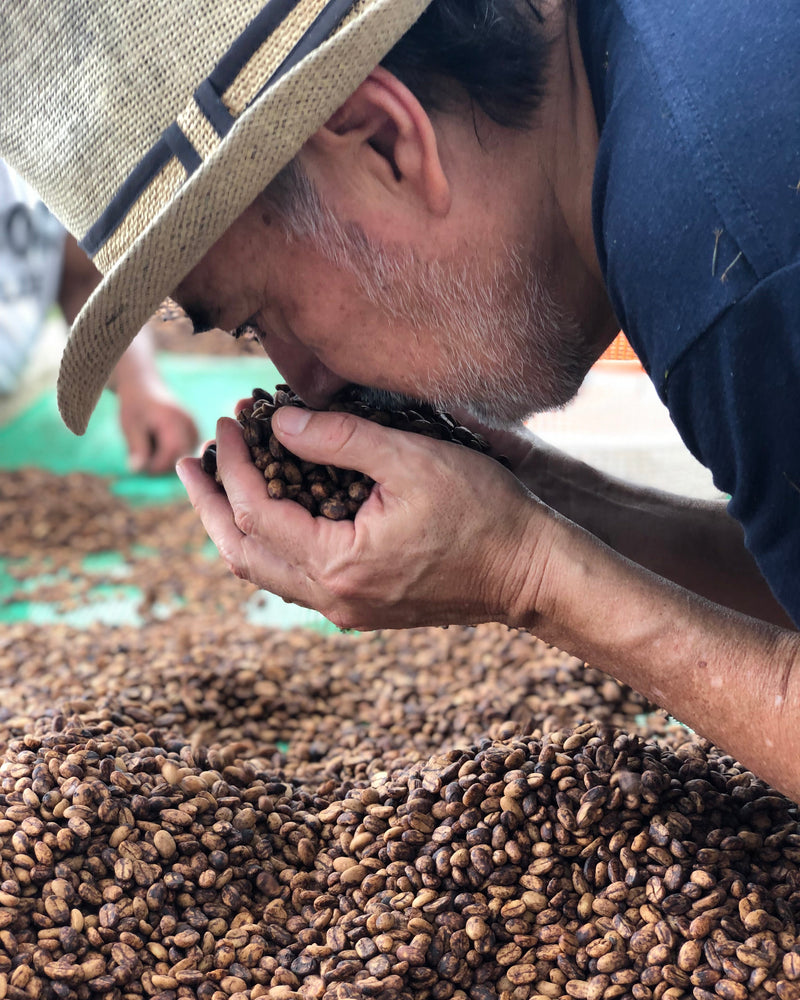
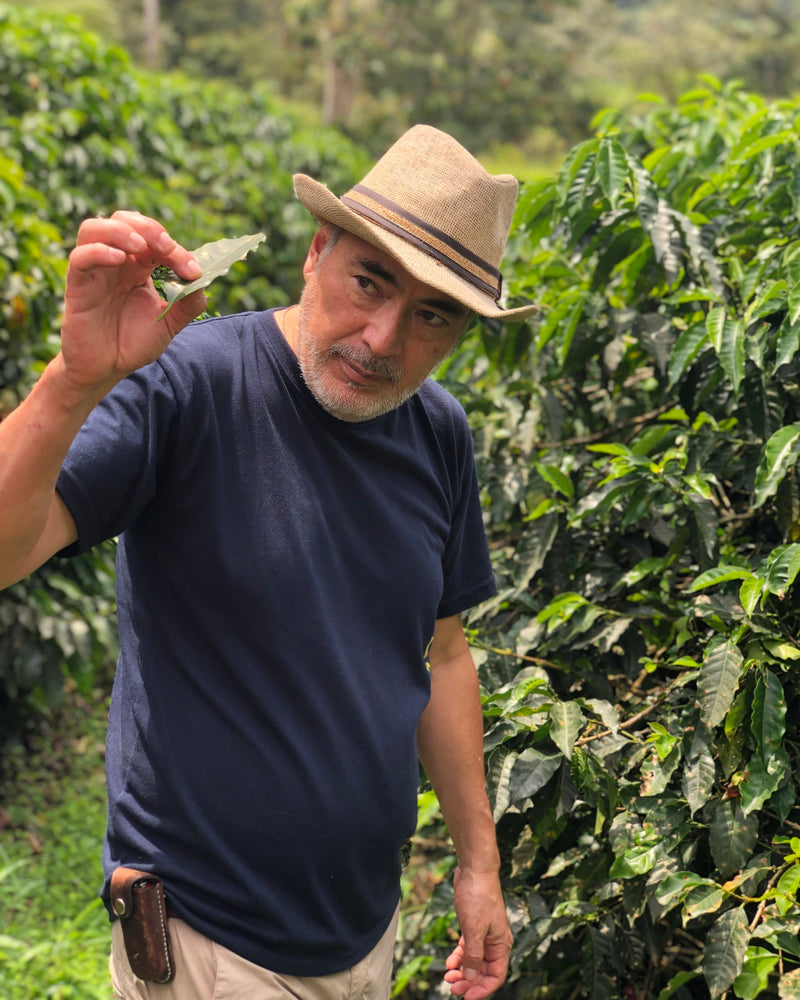
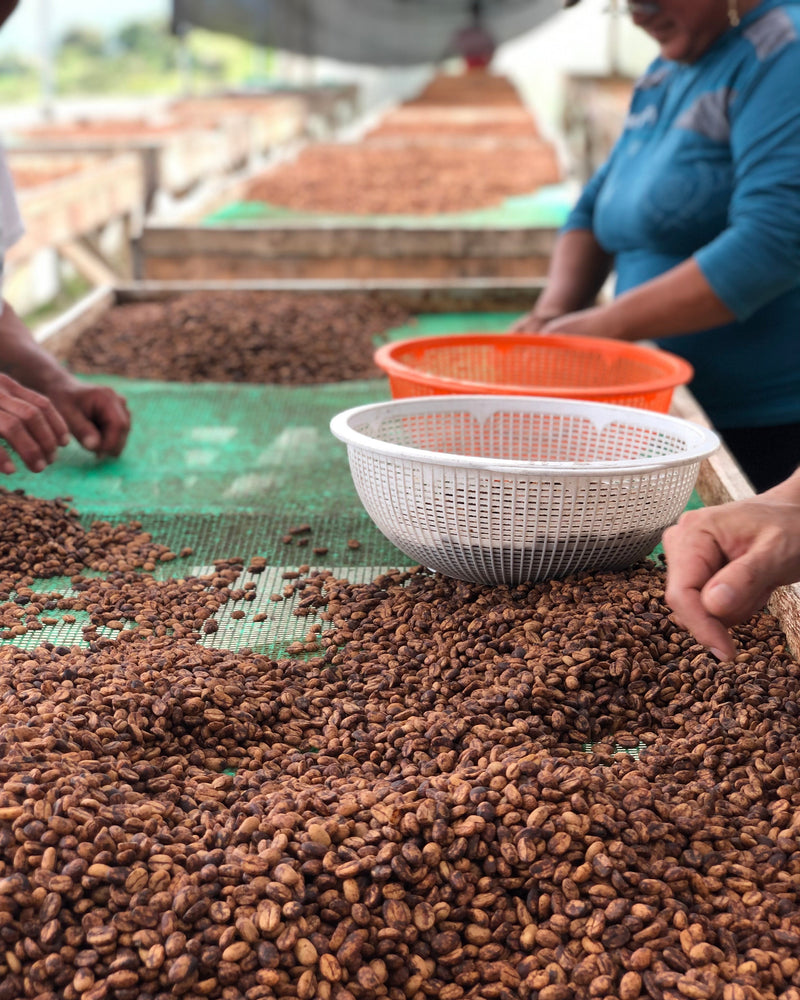
Leopoldo Andrade's farm, La Josefina, is located in Napo Province, Ecuador, at the gateway to the Amazon. From Quito, which sits at an elevation of approximately 2,800 meters, the journey takes you down toward the jungle lowlands, with views of the Napo River along the way. It is a highly unique setting for a coffee farm in Ecuador. With hot springs and active volcanoes nearby, the humid climate influenced by its proximity to the Amazon and its volcanic soil create an environment quite different from other high-altitude coffee-growing regions.
Leopoldo, who works as a banker, started the farm in 2016. The idea came from his wife, Ligia, and a Guatemalan friend who had long encouraged him to start a coffee farm. Through a series of connections and opportunities, he was able to realize his dream of running a farm. Today, he employs people from nearby villages while also working to protect the natural environment of the area. In 2024, he purchased another farm in Pichincha.
Leopoldo describes the area as follows:
“We are close to the Amazon, so it is always humid here. The climate is very different from other regions at higher elevations. We also have a later harvest season than other parts of Ecuador, which means we have fewer opportunities to enter our coffees in competitions.”
In 2025, unusually heavy rainfall caused landslides that blocked the road from Quito to the farm. Meanwhile, people from the local villages continued taking care of the farm on a daily basis, so the impact on the farm itself appears to have been relatively limited.
The Napo River, which runs along the route to the farm, eventually joins the Amazon River in Brazil. Water flowing down from the Andes carries minerals with it, passing through the area's abundant vegetation as it makes its way through the region.
Around 1541, the Spanish explorer Francisco de Orellana is said to have traveled from Quito down the Napo River and across the Amazon River basin, bringing accounts of the river to Europe. One theory also holds that it was Orellana who gave the Amazon River its name.


![[Premium]Ecuador Leopoldo Andrade[Light roast]](http://kurasu.live/cdn/shop/files/image_Beans_Premium-Ecuador-Leopoldo-Andrade_202609_2048x.jpg?v=1788315908)
![[Premium]Ecuador Leopoldo Andrade[Light roast]](http://kurasu.live/cdn/shop/files/Premium_EcuadorLeopoldoAndrade_202609-100_2048x.jpg?v=1788315792)
![[Premium]Ecuador Leopoldo Andrade[Light roast]](http://kurasu.live/cdn/shop/files/Ecuador_Leopoldo_Andrade_2026-100_2048x.jpg?v=1788315922)
![[Premium]Ecuador Leopoldo Andrade[Light roast]](http://kurasu.live/cdn/shop/files/image_Beans_Premium-Ecuador-Leopoldo-Andrade_202609_en_2048x.jpg?v=1788315941)
![[Premium]Ecuador Leopoldo Andrade[Light roast]](http://kurasu.live/cdn/shop/files/IMG_0576_2048x.heic?v=1788315960)
![[Premium]Ecuador Leopoldo Andrade[Light roast]](http://kurasu.live/cdn/shop/files/IMG_0594_2048x.heic?v=1788409668)
![[Premium]Ecuador Leopoldo Andrade[Light roast]](http://kurasu.live/cdn/shop/files/IMG_0599_2048x.heic?v=1788316106)
![[Premium]Ecuador Leopoldo Andrade[Light roast]](http://kurasu.live/cdn/shop/files/IMG_0606_2048x.heic?v=1788316135)
![[Premium]Ecuador Leopoldo Andrade[Light roast]](http://kurasu.live/cdn/shop/files/IMG_0609_2048x.heic?v=1788316163)
![[Premium]Ecuador Leopoldo Andrade[Light roast]](http://kurasu.live/cdn/shop/files/IMG_0613_2048x.heic?v=1788316191)